
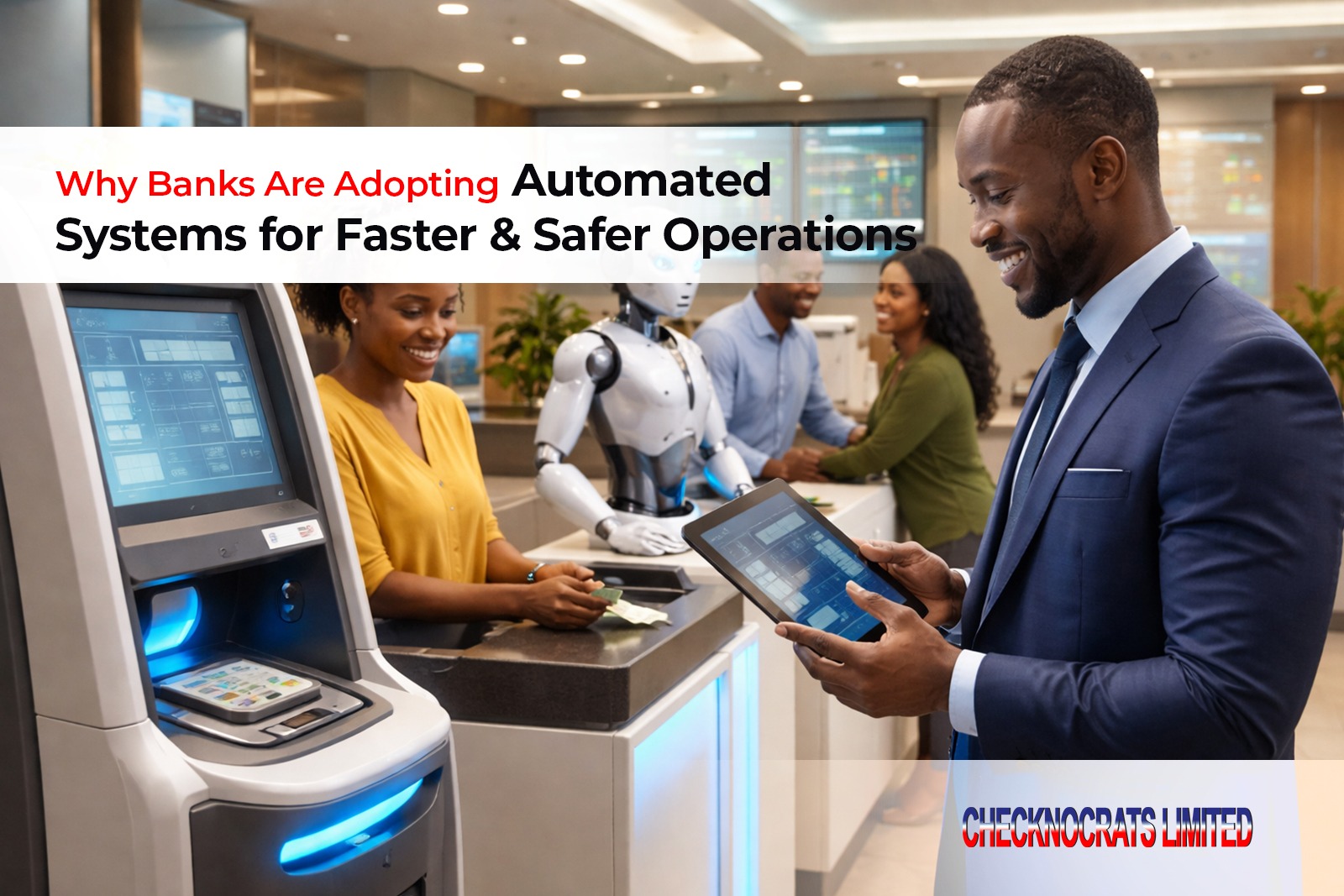
Why Banks Are Adopting Automated Systems for Faster and Safer Operations
The banking industry is transforming at an unprecedented pace. As customer expectations rise and regulatory requirements become more complex, banks are under constant pressure to deliver faster services, improve operational accuracy and strengthen security. Traditional manual processes, once the backbone of banking operations, are no longer sufficient in a world that demands speed, reliability and continuous availability.
This shift has pushed banks to embrace automation as a strategic priority. Automated systems are no longer viewed as optional upgrades they are essential tools for maintaining competitiveness, ensuring compliance, and protecting institutional trust. Checknocrats Limited plays a key role in supporting banks as they modernize their operations through intelligent technology solutions designed for speed, safety and scalability.
The Changing Expectations of Modern Banking
Today’s banking customers expect seamless, real-time services across physical branches, ATMs, mobile apps and digital platforms. Transactions that once took hours or days must now be completed in seconds. At the same time, financial institutions face increasing threats such as fraud, cyberattacks and operational errors.
Banks must balance three critical priorities:
- Faster transaction processing
- Stronger security and compliance
- Operational efficiency at scale
Manual workflows and fragmented systems make this balance difficult to achieve. Automation addresses these gaps by streamlining operations while preserving accuracy and security.
What Automation Means in the Banking Context
Banking automation refers to the use of technology to execute repetitive, rule-based tasks with minimal human intervention. These systems operate continuously, reduce dependency on manual processing and increase consistency across operations.
Common areas of banking automation include:
- Transaction processing
- Cash handling and reconciliation
- Customer onboarding and verification
- Reporting and compliance workflows
By implementing comprehensive Business automation solutions, banks are able to reduce delays, eliminate human error and improve service quality across all customer touchpoints.
Speed as a Competitive Advantage
Faster Transactions and Reduced Waiting Times
Automation enables banks to process high volumes of transactions quickly and accurately. From deposits and withdrawals to account updates and interbank transfers, automated systems significantly reduce processing time.
Key benefits include:
- Quicker customer service at branches
- Lower transaction backlogs
- Improved teller efficiency
- Reduced operational bottlenecks
Speed is no longer a convenience it is a critical differentiator in customer retention and satisfaction.
Improving Accuracy and Reducing Human Error
Even experienced professionals can make mistakes when handling large volumes of data manually. In banking, small errors can have serious consequences, including financial loss and regulatory issues.
Automated systems:
- Follow predefined rules consistently
- Validate transactions in real time
- Generate accurate audit trails
- Reduce dependency on manual checks
This consistency ensures reliable operations while supporting regulatory compliance and internal governance standards.
Strengthening Security Through Automation
Reducing Fraud and Operational Risks
Security is one of the strongest drivers behind banking automation. Automated systems monitor transactions continuously, flag anomalies and enforce strict controls that are difficult to replicate manually.
Banks use automation to:
- Detect suspicious activities faster
- Control access to sensitive systems
- Secure cash handling processes
- Protect customer data
Automation minimizes exposure to both external threats and internal risks while maintaining business continuity.
The Role of Banking Equipment in Automation
Automation in banking is not limited to software. Physical infrastructure plays a critical role in enabling safe and efficient operations. Equipment such as cash recyclers, ATMs, currency counters and smart safes integrate seamlessly with automated systems to support branch efficiency.
Reliable Banking equipment suppliers provide the hardware foundation required for digital transformation.
Modern equipment supports:
- Automated cash verification and sorting
- Secure storage and reconciliation
- Reduced cash handling errors
- Improved branch productivity
This integration reduces workload on staff while increasing security and accuracy.
The Impact on Branch Operations
Smarter, Leaner Bank Branches
Automation has reshaped the role of physical bank branches. Instead of focusing on routine transactions, staff can now dedicate more time to customer engagement, advisory services and relationship management.
Automated systems enable:
- Faster service delivery
- Shorter queues
- Better utilization of human resources
- Enhanced customer experiences
Branches become more efficient, customer-centric, and profitable.
Enhancing Compliance and Reporting
Banking regulations require accurate reporting, audit readiness and transparency. Manual compliance processes are time-consuming and prone to error.
Automation supports compliance by:
- Maintaining accurate transaction logs
- Generating real-time reports
- Enforcing standardized workflows
- Supporting audit and regulatory reviews
This reduces compliance risk while simplifying internal monitoring and governance.
Why Integration Matters in Banking Automation
Isolated systems limit the benefits of automation. Modern banks integrate equipment, software platforms and data systems into unified operational frameworks.
When automation tools work together:
- Information flows seamlessly across departments
- Decision-making becomes faster and more accurate
- Operational visibility improves
- Scalability becomes easier to manage
Integrated Business automation solutions allow banks to adapt quickly to new services, markets and customer needs.
The Importance of Choosing the Right Partners
Automation initiatives are only as strong as the partners behind them. Banks must work with providers who understand both technology and the operational realities of financial institutions.
Checknocrats Limited partners with trusted Banking equipment suppliers to deliver end-to-end automation solutions that combine software intelligence with robust hardware infrastructure.
This approach ensures:
- Reliable system performance
- Seamless integration
- Long-term support and scalability
- Reduced operational risk
Partner expertise plays a key role in ensuring automation projects deliver measurable value.
Cost Optimization Through Automation
While automation requires an initial investment, the long-term financial benefits are substantial. Banks experience reduced operational costs through:
- Lower staffing requirements for routine tasks
- Fewer errors and rework
- Optimized cash management
- Improved asset utilization
Automation transforms cost centers into efficiency drivers, improving profitability without compromising service quality.
Preparing for the Future of Banking
The future of banking is digital, data-driven, and automation-led. Emerging technologies such as artificial intelligence, analytics and predictive systems will further enhance automated banking environments.
Banks that invest today benefit from:
- Greater operational resilience
- Enhanced customer trust
- Better agility in responding to market changes
- Stronger competitive positioning
Automation is no longer a trend it is the foundation of modern banking operations.
Why Checknocrats Limited Is a Trusted Automation Partner
Checknocrats Limited understands the critical role automation plays in modern banking. With deep industry knowledge and a commitment to reliability, the company helps banks implement secure, scalable solutions designed for real-world operations.
By combining intelligent automation tools with proven banking infrastructure, Checknocrats Limited enables financial institutions to operate faster, safer and smarter.
Final Thoughts
Banks operate in one of the most demanding business environments, where speed, security and accuracy are non-negotiable. Automated systems provide the tools banks need to meet these expectations while remaining compliant and competitive.
By embracing automation, banks are not only improving daily operations they are building the foundation for sustainable growth and long-term success. With the right strategy, technology and partners, automation becomes a powerful catalyst for transformation in the banking industry.