
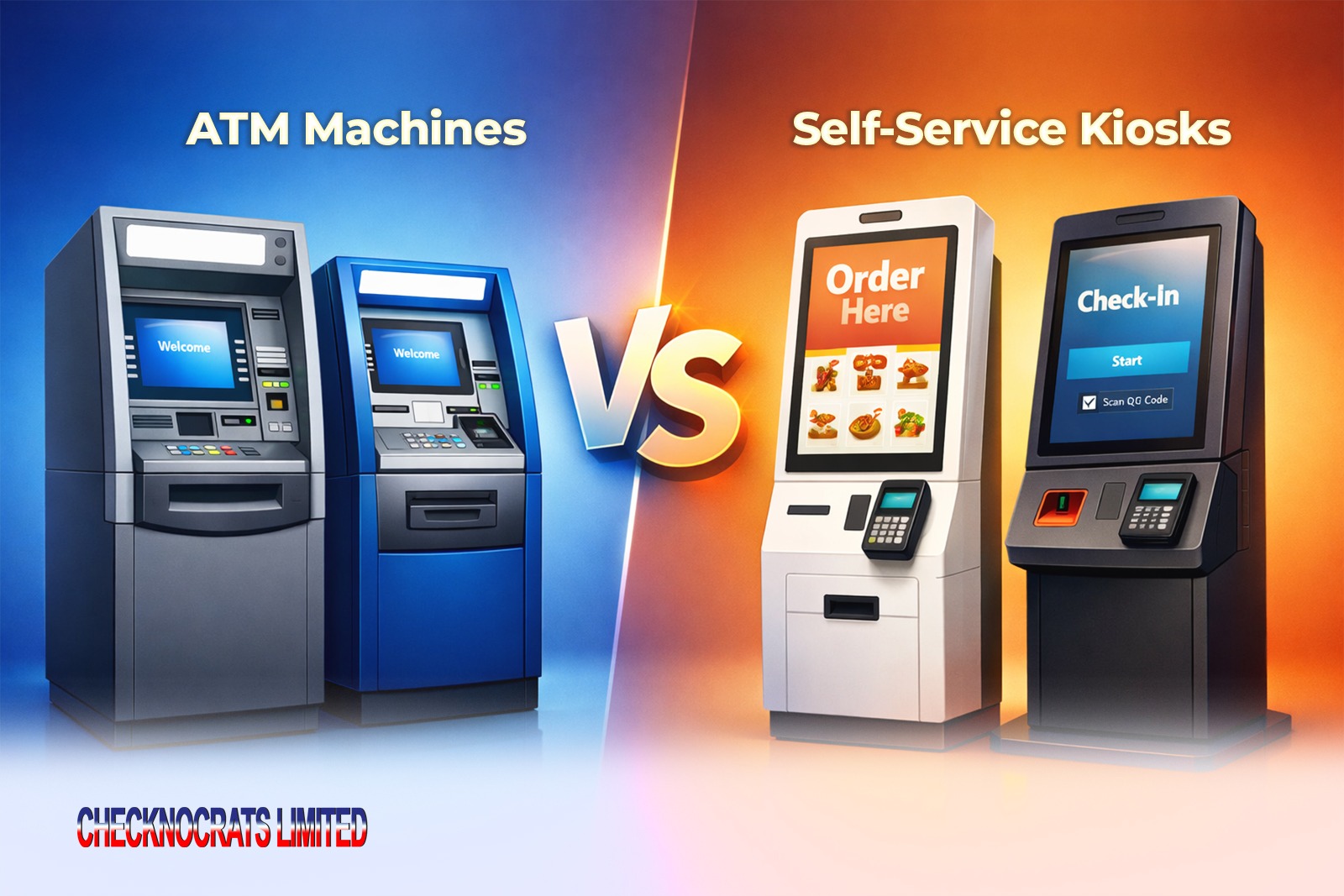
ATM Machines vs Self-Service Kiosks: Understanding the Differences
As customer expectations for speed, convenience, and accessibility continue to rise, organizations are increasingly investing in automated service technologies. Banks, retailers, hospitals, government institutions, and commercial facilities are all adopting self-service systems to reduce wait times, improve service delivery, and operate more efficiently. Two of the most commonly deployed solutions are ATM machines and self-service kiosks.
While both technologies enable automation and reduce dependence on staff, they serve very different purposes. Understanding the differences between ATM machines and self-service kiosks is essential for organizations looking to make informed technology investments. At Checknocrats Limited, we help businesses assess, deploy, and manage the right self-service solutions based on their operational needs and long-term goals.
The Role of Self-Service Technology in Modern Operations
Self-service systems empower customers to complete transactions independently, without human assistance. This approach improves efficiency, reduces operational costs, and ensures availability beyond traditional working hours.
Self-service technology delivers value by:
- Offering faster service delivery
- Reducing queues and congestion
- Improving accuracy and consistency
- Enhancing customer satisfaction
ATM machines and self-service kiosks both fall into this category, but they are designed for different use cases, transaction types and industries.
What Are ATM Machines?
Automated Teller Machines (ATMs) are specialized self-service devices primarily designed for financial transactions. They are commonly deployed by banks and financial institutions to provide customers with secure, round-the-clock access to essential banking services.
Typical ATM functions include:
- Cash withdrawals
- Balance inquiries
- Fund transfers
- Account statements
- Card-based authentication
Organizations investing in ATM machines for sale typically focus on financial reliability, secure cash handling and regulatory compliance.
Core Characteristics of ATM Machines
ATM machines are purpose-built for handling cash securely and efficiently. They integrate robust hardware, specialized software and high-level security protocols.
Key characteristics include:
- Encrypted financial transactions
- Physical security features such as safes and vaults
- Integration with banking networks
- Compliance with financial regulations
Because of their specialized nature, ATMs require proper planning, placement, and technical integration.
What Are Self-Service Kiosks?
Self-service kiosks are versatile automated terminals used across multiple industries. Unlike ATMs, kiosks are not limited to financial transactions. They support a wide range of customer interactions depending on software configuration.
Common kiosk applications include:
- Bill payments
- Ticketing and registrations
- Information lookup
- Order placement and check-in
- Government and utility services
Organizations deploy Self service kiosks to streamline operations and improve customer engagement in both public and private environments.
Core Characteristics of Self-Service Kiosks
Self-service kiosks are designed for flexibility rather than specialization. They rely heavily on software customization to meet business requirements.
Notable features include:
- Touchscreen interfaces
- Modular software platforms
- Compatibility with multiple peripherals
- Scalable and update-friendly architecture
This flexibility makes kiosks suitable for a wide range of industries, including healthcare, retail, hospitality and public services.
Key Differences Between ATM Machines and Self-Service Kiosks
Purpose and Functionality
ATM machines are purpose-driven tools focused on financial transactions, while kiosks are multifunctional platforms designed to handle a variety of service workflows.
ATMs prioritize:
- Cash handling accuracy
- Financial security
- Transaction integrity
Kiosks prioritize:
- User interaction
- Workflow automation
- Service flexibility
Transaction Types
ATM machines deal primarily with monetary transactions involving bank accounts. Self-service kiosks handle both financial and non-financial interactions, depending on software design.
Because of this, kiosks can evolve more easily as service requirements change, while ATMs remain specialized.
Security Requirements
ATMs require rigorous security frameworks, including physical, network and data protection measures. Self-service kiosks also require security, but the level varies based on application.
Businesses deploying ATM solutions must ensure professional ATM installation services are used to maintain compliance and system reliability.
Customization and Scalability
Self-service kiosks offer greater customization. New features, services or workflows can be added through software updates.
ATM machines, while highly reliable are less flexible in terms of expanding functionality beyond core banking services.
Installation and Deployment Considerations
ATM installations are complex projects that require:
- Site assessment
- Network integration
- Physical security setup
- Regulatory approval
Professional ATM installation services ensure systems are deployed correctly and operate safely from day one.
Kiosks, in contrast, are generally easier to deploy and scale, making them ideal for businesses looking for rapid service expansion.
Cost and Return on Investment
Both systems require upfront investment, but the return on investment differs.
ATM machines produce ROI through:
- Transaction fees
- Customer convenience
- Reduced branch dependence
Self-service kiosks deliver ROI by:
- Lower staffing costs
- Faster service delivery
- Improved customer satisfaction
The choice depends on whether the organization’s primary goal is financial service delivery or general customer engagement.
Industry Use Cases
Banking and Financial Institutions
Banks rely heavily on ATMs to extend services beyond physical branches. Institutions considering ATM machines for sale focus on reliability, security and long-term performance.
Retail, Healthcare, and Public Services
Retail outlets, hospitals, and government offices benefit greatly from kiosks that reduce waiting times and automate routine interactions.
These organizations increasingly deploy Self service kiosks as part of their digital transformation strategy.
Choosing the Right Solution for Your Organization
The decision between ATM machines and self-service kiosks should be based on:
- Nature of services offered
- Customer behavior and expectations
- Security and compliance requirements
- Long-term scalability goals
Some organizations even adopt hybrid models using ATMs for financial transactions and kiosks for support services to create a comprehensive self-service ecosystem.
The Role of Checknocrats Limited
Checknocrats Limited works closely with organizations to assess requirements, recommend appropriate technologies and deliver professional deployment. Whether the need is for secure ATM infrastructure or flexible self-service solutions, the company provides end-to-end support.
Through experience, technical expertise and trusted partnerships, Checknocrats Limited ensures that self-service investments translate into real operational value.
Final Thoughts
ATM machines and self-service kiosks may appear similar at first glance, but they serve distinctly different purposes. ATM machines are specialized financial systems focused on secure cash transactions, while self-service kiosks are adaptable platforms designed to improve service efficiency across industries.
Choosing the right solution requires understanding business objectives, customer needs and operational priorities. With the right strategy and expert guidance, organizations can leverage self-service technology to reduce costs, enhance customer experience and support long-term growth.